A different kind of project

After spending much of my career involved in the management of oil and gas projects, receiving an invitation from Save the Children to view some of their projects made me curious. Curious from a professional point of view, regardless of the many other reasons why I wanted to go. So when I returned earlier this month to visit my old colleagues at ADIL in Aberdeen I enjoyed the chance to talk about the way the projects were managed, as well as about the overall importance of the charity’s work.

The projects we saw in Delhi and Rajasthan were on the surface very different from ones I had been involved in the oil and gas business. But then as I saw these projects, and observed the way Save the Children were selecting and managing them, I was struck by the similarities with the best of practices from my own industry.

The projects were not grand ventures, but rather attempts to find simple solutions to some profoundly difficult problems. We met local Save the Children staff as we travelled, hearing from them about their strategies and plans as well as actually seeing the projects. These are talented and dedicated people, and are part of an organisation that stands up to comparison with any of the organisations that I have worked for. And from what I saw I’m certain that they are making a difference to the lives of many children in India.

Save the Children have very clear goals in India, and their projects are well aligned with these goals. I loved the way they found innovative, simple solutions. I admired the patience of their execution, and the way they empowered the communities that they work with. The way they leverage government money, and their strict control of costs gets the most from every pound that is donated. And I saw many examples of the way they monitor performance on the projects, linking directly back to their goals.
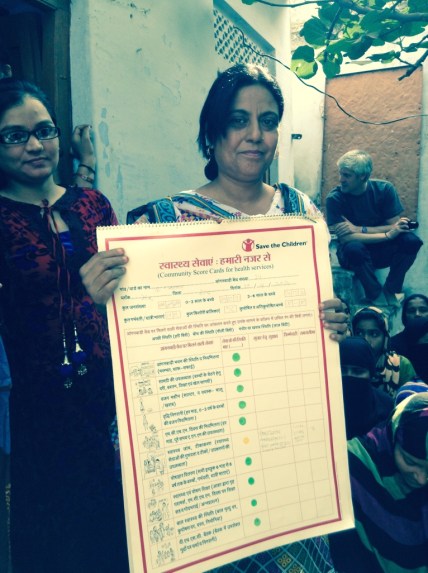
thumb_IMG_0068_1024
Proud to show her project’s progress

We were able to see some wonderful projects, and it is clear to me that Save the Children are able to make a real difference to the life chances of some very deprived and vulnerable children. I came back convinced that this is a good effective organisation to support in the fight for the world’s children. In a world that has many important causes which need our support this remains one that is critical to all our futures.
 

Christmas Quiz – part 2

Happy Christmas everyone!

Here is the second part of the Christmas quiz.  You should have your answers from yesterday’s episode already, and when you’ve finished this section you’ll be able to check the answers and send me your overall score to win the valuable first prize! *

Thank you again for your interest in my blog over the last couple of months. I hope you’ll keep up with it in 2016 as I update it on the follow up to the visit.

I hope you enjoy finishing the quiz!

* To win the prize send your score to andyrhalliwell@gmail.com

The India Christmas Quiz – part 2

11) What was the worst of Richard’s puns on his blogs?

a) A Stonking Day (after a visit to Tonk)
b) Slum dog will in the air
c) Hard to say – they were all as bad as each other!

12) What does Sheila not do?

a) Play in a local orchestra
b) Work in a parenting assessment centre
c) Relax quietly while waiting for her baggage to arrive

13) How many children are reported to be sent away from the Dungarpur region to work (illegally) in the cotton fields of Gujarat every year?

a) 400
b) 4,000
c) 40,000

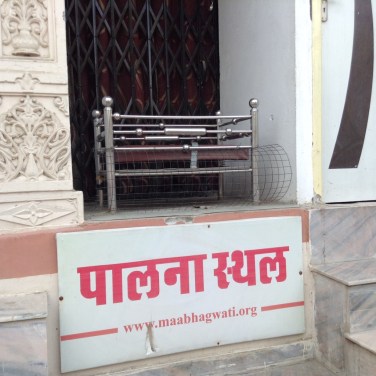
14) One of the most moving symbols of child suffering that we saw was the cradle installed outside the hospital in Udaipur. It means that rather than being literally thrown away, rejected babies can be offered the care they need to survive.

thumb_IMG_0105_1024

At the time we visited how many times had it been used in the last 8 years?

a) 25
b) 48
c) 129

15) How many official slums are there in Delhi?

a) 68
b) 450
c) 628

16) Which of these is not true?

a) The population of Delhi is increasing by 700,000 people each year
b) A quarter of Delhi households have no water supply
c) More people are killed on India’s roads each year than young children who die of diarrhoea

17) What is chai?

a) A spicy milk tea
b) A mixture of hot chocolate and coffee
c) The Indian equivalent of Pepsi

18) We loved the chance to interact with groups of children who had benefited from the Save the Children programmes. What was the best question (IMHO) that we heard?

a) Why have you come to India?
b) Can you help raise more money to support us?
c) Will you play with us?

19) What was the score in the children vs Save the Children Supporters steal the handkerchief game?

a) Children 5 Supporters 2 ( Home advantage told)
b) Children 5 Supporters 5 (They were kind and didn’t want to hurt our feelings!)
c) Children 0 Supporters 2 (Supporters’ innate competitive instincts came through)

20) How much of every £1 raised by Save the Children goes directly to support children

a) 88p
b) 75p
c) 61p


I’ve enjoyed this quiz so much I want to donate to Save the Children! How can I do it?

a) through this link Save the Children – India visit
b) buying a last-minute e-gift for someone on the Save the Children website Christmas gifts
c) a cash donation on the Save the Children web site (Save the Children )
d) all of the above

Thanks, and good luck!

Christmas Quiz

To help you fill those few quiet moments over the Christmas holidays, why not try this fabulous Save the Children India Visit Quiz? Not only can you relive the excitement of the visit itself, you can also win a valuable prize! Send me your overall score, and the highest scores will go in a raffle for the big prize – yes you guessed it – a Save the Children t-shirt! *

The quiz is in two easily digestible parts – the second part comes on Christmas day.   You can find the answers to nearly all of the questions in the various team-member’s blogs, or if you’re feeling confident you could just take a chance and guess. It all depends on how much you want that prize!  You can check your score against the answers page at the bottom of the blog.

Seriously, though, thank you for your interest over the last couple of months. I hope you’ll keep up with the blog in 2016 as I update it on the follow up to the visit.

Happy Christmas, and I hope you enjoy the quiz!

* To win the prize send your overall score to andyrhalliwell@gmail.com

The India Christmas Quiz

1) Who are the 5 Save the Children supporters who visited India in November?

thumb_on our way_1024

a) Richard, Jenny, Terry, Sheila, Andy
b) Richard, Fiona, Terry, Sheila, Kris
c) Richard, Elizabeth, Terry, Sheila, Andy

2) What do Save the Children do?

a) They save children’s lives
b) They fight for children’s rights
c) They help children achieve their potential
d) all of the above

3) Eglantyne Jebb, the founder of Save the Children, published the first Declaration of the Rights of the Child in 1923.  When was the UN Convention on the Rights of the Child finally adopted?

a) 1925
b) 1950
c) 1989

4) The rights of the Child contained in the UN CRC are often summarised in four main categories.  What are they? (ps you can read about child rights in the page listed at the foot of my blog)

a) survival,
b) protection,
c) development,
d) participation
e) all of the above

5) What is the unmissable fact about Elizabeth that the Hampshire Chronicle picked up on?

a) she has supported Save the Children for almost 50 years
b) she is a grandmother of 12
c) she is a very talented artist (you can see some of her sketches on her blog)

6) What was Terry’s favourite drink?

a) Beer
b) Chai
c) Bottled water

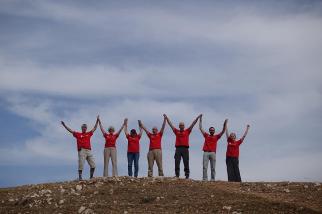
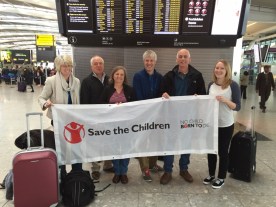
7) At the end of the visit we all mimicked the Save the Children emblem. charlie

What is this human version of the Save the Children emblem called?

a) an “Andy”
b) a “Bobby”
c) a “Charlie”

8) We visited a number of Anganwadi centres (government provided centres to combat child hunger and malnutrition).   What does Anganwadi mean?

a) courtyard shelter
b) Community Centre
c) Food bank

9) We saw established programmes in action, but Save the Children are also actively involved in many emergency areas throughout the world. How many emergency areas did Save the Children work in during 2014

a) 60
b) 87
c) 103

10) What is “Plumpy-nut”?

a) an impolite description of Andy after too much Christmas pudding
b) a high nutrient food bar used to treat severely malnourished children
c) the favourite chocolate bar in Delhi

I hope you’re impatient for more!  Join me on Christmas Day for the second part of the quiz.


The Race for Survival

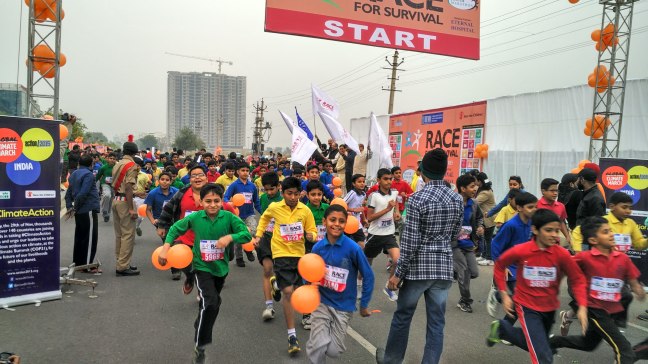
You might remember that as we left our hosts for the last 3 days of the trip, Hemant and UP, were heading back to Jaipur to be part of the Race for Survival.  The event was a great success – five thousand children of all ages took part in the race, spreading the message on gender equality. They ran with orange balloons to make the pink city orange for the day,  and to send out a message “End Violence against Women”.  I’m sure you’ll appreciate from many recent news stories how important it is for India to address the problem of violence against women, so it was gratifying for us to see how gender equality was a keystone in all the Save the Children projects we visited.

IMG_20151128_080237_HDR


A colourful day…..


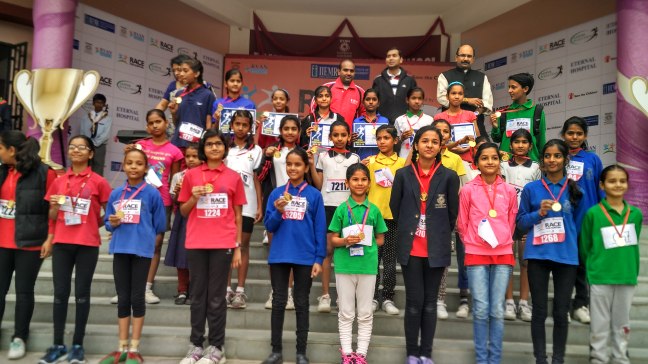
I’m sure everyone will be a winner from events like these, but these few went home with the medals…

IMG_20151128_093129_HDR

7 days in 7 minutes

Yesterday Hemant sent us through some photos that he had taken while he was showing us the Save the Children Rajasthan projects.  You can see that we have to add photography to the long list of his talents!   I’ve included many of the photos in a short photomontage that I’ve put together to help me remember what we saw during our visit.  You can see that if you click on this link

7 minute photo montage

I hope that you enjoy it even half as much as I did putting it together!


thumb_IMG_20151126_163255_HDR_1024
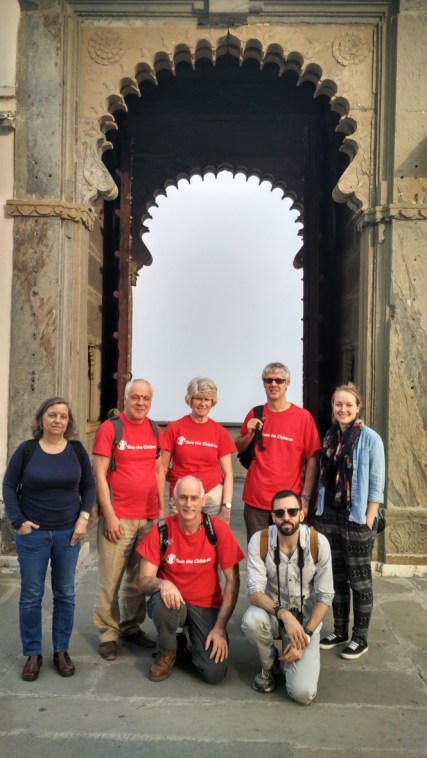
The team photo 
thumb_IMG_20151127_134305_1024
At the end of the day…


What about Save the Children?

Yesterday I shared Terry’s heart-felt thoughts as he returned home, but there is another aspect of the visit that I would like to say something about – something that struck me increasingly as the week went on, and that is of fundamental importance for us as donors. How good a job are Save the Children doing with our donations?

As we travelled with them I was more and more impressed by the Save the Children team and the work that are doing. I had expected to see dedicated people and I was not disappointed. I also expected to see people who cared deeply about what they are doing, and we found that in spades. And I had expected to see people who were good at their job, but what I hadn’t expected to see was such a competent and professional organisation, one that stands up to  comparison with any of the organisations that I have worked for.

Their approach to strategy was clear and disciplined, helping them figure out what were the most important things for them to be working on, and then they go on to do what’s needed.  They are very good at building the networks they need to make change – working with communities, government and other NGO’s.   And they are not frightened to take on really difficult projects –   in the past I’ve been involved in trying to effect change in large organisations and know how difficult that is,  but they are trying to change attitudes and behaviours in major populations.

The people we spent  most time with were Sanjib and Shamaila in Delhi, Hermant, O.P. and Sanjay in Jaipur, Jaswinder in Tonk and Nima in Dungarpur. Thank you all so much for your wonderful work and for taking the time to show us what you do. Thanks too to all the others who were involved in the trip, too many to mention here.

Sanjib and Shamaila at work

And of course a big thank you to Jenny and Kris, who did such a wonderful job organising the whole visit, and kept us on track throughout.

thumb_IMG_0121_1024
Jenny and Kris relax for a brief moment!

The bottom line for me is that I came back convinced that this is a good effective organisation to support in the fight for the world’s children. I hope you agree. If you do, please consider making a donation to them, either case or making a commitment to leave a donation in your will. You can do that on their website through this link Save the Children

What to make of it all.

Now I’m back home and reflecting on what has been a memorable week. I will long remember the amazing Save the Children team in India, the many wonderful children and families we met, the projects that we saw, and the new friends I’ve made with the wonderful people on the supporters team who travelled there with me.

I had thought that today I would write something to summarise the week, and then yesterday I read my new friend Terry’s blog. He has written so beautifully about his reactions that straight away I wanted to share it. I agree with everything he has written…..

Save the Children do some great work and we have seen some wonderful projects over the last week. They make a real difference to the life chances of some very deprived and vulnerable children and I felt very proud at times to, literally, ‘wear the shirt’. Despite the fantastic work that Save the Children do many of the children’s circumstances that we met were pretty grim. You can’t put a gloss on living in a slum where the average space per family is little more than 6ft by 6ft and knowing your rights means very little if those rights are not realised. I still fear that many of the girls will be mums long before they are out of their teens and the boys will have to leave school too in order to become daily wage labourers. I wouldn’t want my children growing up in those circumstances and neither would you. So the work of Save the Children remains as needed and as vital as ever. But it would be wrong to portray the children we met solely as victims. They are resilient and optimistic for their futures. They knew how to play, laugh and have fun and they certainly didn’t seek out sympathy or charity. I will not forget them. They confirmed my view that whatever their nationality, culture , religion or anything else you can throw in the mix , childhood  has a universal commonality and the children in the slums of Delhi or the deprived rural areas of Rajasthan will have more in common with my children and your children than they will have differences. I also believe that it’s up to the adults of the world to defend (vigorously) that notion of childhood.

So, with apologies for the cliché … my journey to India with Save the Children is over. But for the children I feel privileged to have met and with whom, if only briefly, our lives met and connected, their journey of life is only just beginning. I hope that they get the chance to fulfil their undoubted potential. To them I say thank you for being pivotal in one of the most significant weeks of my life. Take care, good luck on your journey, and travel well.

Thank you Terry. I can’t think of a better summary of what we experienced  last week.

Save-the-Children_logo


Mutual Well-being

Nima is the Save the Children staff member in Dungarpur, and it was inspiring to hear her passion when she talked about the programmes and when she was with the children on our field visits. Another programme she told us about was the Community Health Protection Programme. This is directly funded by Save the Children in response to a very high infant mortality rate. and is a very different project than I expected to see here.

The profound belief in faith-healers, compounded by poor health infrastructure increases means its too long before people seek proper help, so diseases are prevalent and health costs for families escalate. Save the Children have helped set up a kind of mutual health care arrangement which is managed by a group of about 15 women from the area, with advice and support from Save the Children staff. This scheme provides coverage for health care costs and loss of income for an affordable premium. Save the Children are also providing basic health care in these remote areas – in Padili we met with two volunteers who have been trained as nurses to care for local children. All this, coupled with discounts negotiated with the region’s hospitals, means that children are receiving better health care and are also less likely to be forced to work if their parents are ill. Richard described the story of how one little girl was helped in his blog on Friday – why not take a look.

I have loved the diversity of approaches that Save the Children are using here, and the way that there is always an emphasis on community involvement.

So at the end of our day in Padili it was time to start our long journey home. We smiled  on the way back when we stopped for something to eat in a local restaurant and the owner recognised us from our Save the Children tee-shirts. He told us that he had seen us on the TV over the previous 2 days – odd to be recognised so many miles from home! Let’s hope that the press coverage can help in some small way to get Save the Children’s messages across.

I’m home now, but still have one or two things about the trip that I’d like to share. I hope you’ll keep your eye open and support the blog for a few days more.

Why are they dancing in Dungarpur?

The region that we visited yesterday was close to Dungarpur – it’s a fascinating area, very remote and isolated which has left it very poor. There are significant cultural differences from the rest of India and it’s the only area in India where there are more girls than boys. This has come about because of the traditional culture of the tribes where women have a dominant role. For example it is accepted for a woman to have a family with one man, then move on to have another family with a different man, (a practice called nata). This can lead to some complex extended families, which in turn can cause problems for the children.

Here there isn’t the discrimination against female babies that I wrote about a couple of days ago in Udaipur. The impact can be seen in the numbers in the schools (the local teacher told us he had 70% girls in his class), or just in the mix of young children walking by the road. And if you look at who is hanging off the side of public transport it is just as likely to be a girl as a boy, definitely something you wouldn’t see elsewhere.

Images from Padili

Because of the poverty, many of the children in the area are sent to work to help earn for their families – this could be in the local fields, or they could go away to work (illegally) in the cotton fields of Gujarat. It’s reported that 40,000 children from this area are involved in that industry – a horrific story of child exploitation. The government has a number of schemes which aim to give a basic level of income to the poorest families, but often the benefits do not flow through to the children. So there’s good reason for Save the Children to be working here.

The local staff told us about their Child Sensitive Social Protection project which works with children in many situations, aiming to boost their confidence and their understanding of children’s rights. The children we met yesterday were being helped by the programme. It also provides training to the extended family carers to help them understand children’s needs and rights.

There are lots of activities used to get these messages across. We stopped en route to Padili and were treated to see a folk theatre performance by a group of adults including role-play and dance to illustrate the impact of traditional attitudes on children. It was enthusiastically performed and well received by the local audience. When the programme is extended outside the region it won’t just be in Dungarpur that they will be dancing!

thumb_IMG_0126_1024
Watching the folk theatre performance!

ps if you’re in the dancing mood and want to see the welcome dance from Govindpuri school, you can catch it on https://youtu.be/BgA2nM6XZxE

The best question

I love questions, and today I was asked one of the finest questions that I remember. We had travelled to Padili, a remote tribal village close to the Rajhastan border with Gujarat, and were meeting with a group of children who were part of Save the Children’s Child Sensitive Social Protection project. I’ll tell you more about that at some point, but first to that question.

We had walked a fair distance across the fields from the community centre to meet the children from the local villages and the Save the Children volunteers at their regular meeting place. They greeted us with traditional ceremony, and were delighted when we handed over some small gifts – skipping ropes, balls, and such like. It was fantastic to see the children’s excitement as they chased bubbles, balls and balloons, and learned to skip. But then it was time to get to business and so we all sat down in a circle on the ground and we asked them questions, which they answered politely. They enjoyed going to the Save the Children run centre, they liked painting, and had made new friends. When we asked them a tougher question “What do you know about children’s rights?” a young boy answered perfectly – “Every child has the right to an education, to be healthy, to grow up safe and to be heard”. Education about children’s rights is a major piece of the Save the Children programme so it was good to hear that this is getting through. Finally we suggested that they might like to ask us some questions, and that’s when it came out.

A young girl quietly asked us “Will you play with us?”, and that changed the day. We said yes, and then decided together to play steal the handkerchief. It was fantastic fun even if the children beat the Save the Children team soundly! (But then they had practiced more recently than we had!) What a memorable moment.

Later as we drove away, I thought about what a fabulous question that was. We’d gone to meet the children and were firmly in our adult world of questions and answers. Then this young girl had the courage to say what she wanted, and things changed. What a beautiful metaphor for some of the fundamental rights of a child – to be heard, and to be a child.

That was our last visit, and a fitting climax to what has been a truly memorable trip. We left Padili and straight away started our long journey home. It’s late now and we have an early start tomorrow so I’ll leave it there for now. Tomorrow while we travel I hope I’ll have more time to tell you about the other things that we saw and learned about on today’s visits – there’s a lot still to tell.